
Is It Safe to Get Dental Implants Overseas? What the Evidence Shows

You've got a quote for full-arch implants in Australia, somewhere between $25,000 and $45,000. Then you found a clinic in Bali or Vietnam offering close to the same treatment for a fraction of that price. Now you're trying to work out if the risk is worth the savings.
Most of what you'll find online doesn't actually answer that question. It treats a dental implant the same as a filling or a crown. It isn't the same. An implant is a small operation followed by months of healing. That difference changes almost everything about whether a trip overseas makes sense.
Why implants carry more risk than other dental tourism procedures
A filling takes one visit. A crown usually takes two. You sit in the chair, the work gets done, and you fly home a day or two later with nothing left to monitor.
A dental implant works differently. The dentist places a small titanium post into your jawbone. Your body then needs time to grow bone around that post and lock it firmly in place. This process is called osseointegration, and it normally takes 3 to 6 months. Only once healing is complete does the dentist attach the small connector piece, called the abutment, and the final crown or bridge on top.
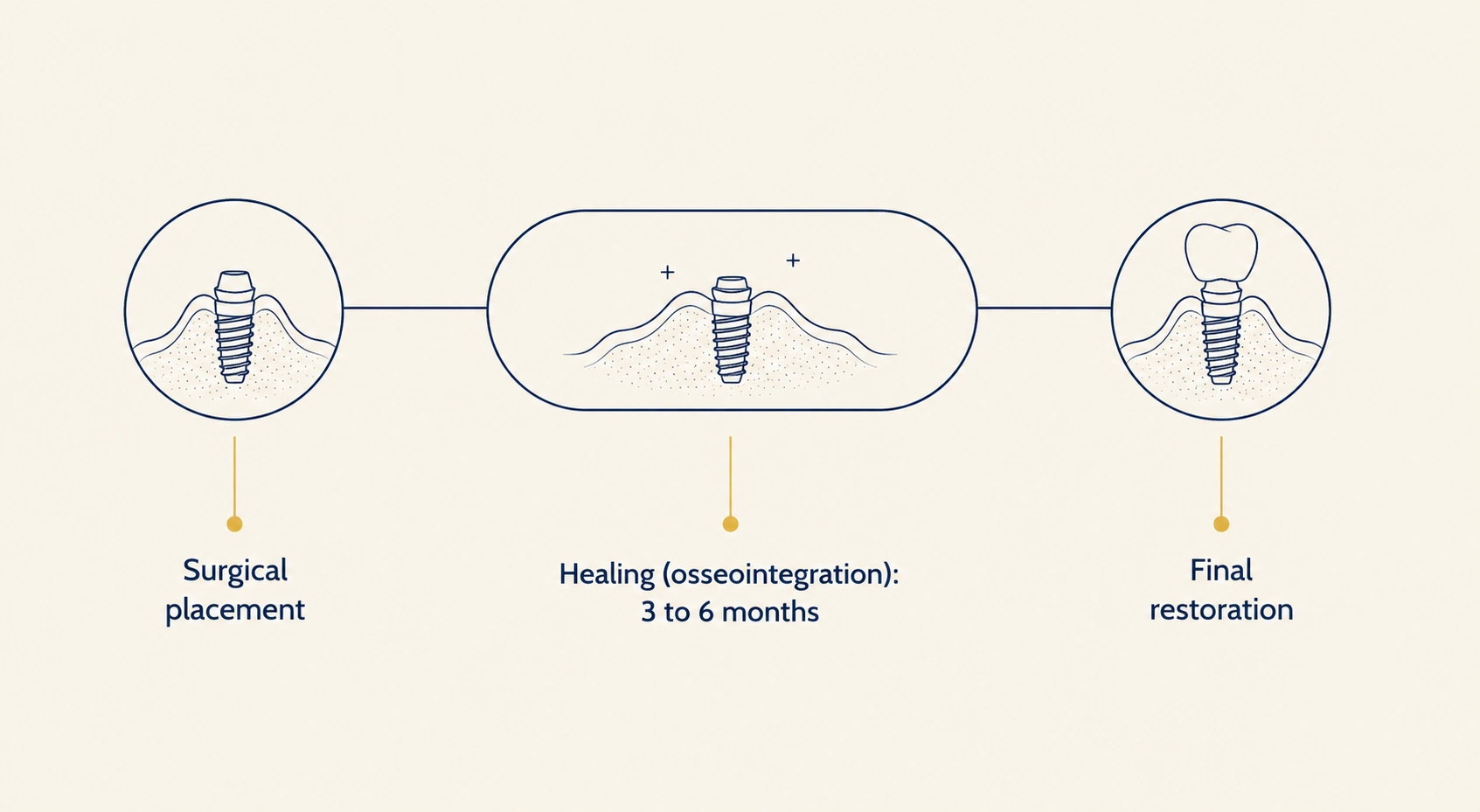
Full-arch treatment raises the stakes further. You're not fixing one tooth. You're placing multiple implants across your whole upper or lower jaw. The replacement teeth that sit on top need to fit precisely across every implant at once. More implants means more chances something needs attention during healing.
The real risks, and what the generic warnings leave out
The Australian Dental Association has warned about dental tourism for years. In August 2024, ADA President Dr Scott Davis spoke publicly after a Queensland retiree travelled to India for dental work and came home needing more than $50,000 in remedial treatment. Davis said some patients get good care overseas. But he's also seen crowns that don't fit or are the wrong colour, along with ongoing sensitivity and dead nerves. Other cases involved decay left untreated, and teeth extracted with the roots still in place.
Those warnings cover dental tourism in general, from teeth whitening to root canals. They don't say which parts matter more for implants specifically.
Training and regulatory standards
Every dentist practising in Australia is registered under one national system. It's run by the Dental Board of Australia and supported by AHPRA. That means consistent education and ongoing training, no matter which state or clinic you visit.
Overseas, standards vary by country and clinic. We see clinics on both ends of that range. A polished website often doesn't tell you which one you're looking at. This matters more as the case gets bigger. More implants means more stages where standards can slip.
Infection control
Australian clinics must follow consistent sterilisation and infection control rules to stay registered. You don't need to check this yourself.
Overseas, infection control varies the same way training does, by clinic and country. You can't judge it from a few photos of a treatment room.
Treatment timing across multiple visits
This matters most for implants specifically. Full-arch treatment needs a 3 to 6 month healing gap between the surgery and the final restoration. Compress that gap to fit inside a single holiday, and a clinic has two choices. It can use a faster protocol that may or may not suit your case. Or it can send you home partway through treatment and ask you to fly back months later for the final stage.
Full-arch patients tend to plan for one trip. Most cases need at least two, months apart. Ask your clinic how many separate trips your case will realistically need before you book flights.
Scott Davis, a consultant prosthodontist and Australian Dental Association spokesperson, told the ABC he regularly sees complications from compressed timelines. Patients try to fit three to six months of healing into a two-week trip, and as he put it, "biology just doesn't listen to that.
What happens if your implant fails after you're home?
Australian dentists take on corrective work for implants placed overseas. The Australian Dental Journal published a case report on exactly this in 2012. A patient comes home with a problem, and the treating dentist in Australia has to work out what was actually placed in their jaw.
That's harder than it sounds. Patients rarely carry documentation of which implant system was used. Often, the only clue is an X-ray, and different implant systems can look almost identical. The case report describes dentists using specialised identification tools. These tools match implants to their appearance on an X-ray.
Not only is an unidentified implant inconvenient to replace, but it's a legal problem. Under the Therapeutic Goods Act 1989, it's a criminal offence to import or supply a medical device that isn't listed on Australia's official register of approved devices. If the implant system used overseas was never registered here, your Australian dentist may not legally be able to order the exact replacement part. "Compatible" parts exist for some systems, but they carry no warranty and may not fit as precisely as the original.
None of this means you're stuck if something goes wrong. Your options depend heavily on one thing: whether you know exactly which implant brand and system was used. Ask for this before you book, not after you land. It's one of the most useful questions you can ask an overseas clinic.
If something goes wrong once you're home, there's a limit to what the Australian Government can do about it. Australia's official Smartraveller advice on medical tourism spells out exactly what that limit is. Consular staff can't pay your medical or legal costs. They also can't represent you in a legal case or step into a foreign country's legal process on your behalf. That makes it your problem to solve, not something an Australian agency will chase for you.
Is it actually cheaper once everything is counted?
Dental costs in Australia are a financial pressure for a lot of people. That's exactly why overseas treatment looks appealing in the first place. Dental treatment is now the biggest reason Australians tap their superannuation early. In 2024-25, the Australian Taxation Office approved more early access to superannuation for dental treatment than for any other compassionate-release category. That single category accounted for $817.6 million released that year, up 55% on the year before.
Against that backdrop, here's how the two options compare.
That Australian price reflects the number of implants involved, the surgical planning, and the custom-made prosthesis that has to fit precisely across the whole jaw. A full arch at a premium Vietnamese clinic, for example, costs about a third of the Australian premium price for the same treatment.
For full-arch treatment, the gap usually stays wide even after travel costs. The underlying price difference is tens of thousands of dollars, not thousands, so the savings tend to survive the trip.
What doesn't show up in either quote is the risk of needing corrective work later. If the implant system used overseas can't be traced back to a registered brand, that risk gets harder to predict and more expensive to fix.
One more thing worth checking: Medicare doesn't cover dental implants in Australia or overseas. If you hold private health insurance, implants usually sit under "Major Dental" extras cover. That often comes with a waiting period, and it pays only a partial rebate. Check with your own fund about how they treat treatment received overseas, because this varies between funds.
Who might reasonably consider it, and who probably shouldn't
More reasonable when:
- It's a simpler case, like a single implant or two without major bone loss
- You can plan two separate trips, months apart, instead of one
- An Australian dentist is willing to check on you between trips
- The clinic confirms the implant brand and system in writing before you book
Probably not when:
- It's a complex case involving several implants, bone loss, or grafting
- You're only planning one trip, with no return visit built in
- You don't have a local dentist lined up to monitor healing
- The clinic is vague about the implant brand or won't put it in writing
Common questions about dental tourism and implants
Is dental tourism safe?
It can be, and it can also go badly. The country matters less than you'd think. What matters more is the clinic itself, and how realistically the treatment timeline is planned. Implants go through more stages than a filling or teeth whitening: surgery, months of healing, then the final restoration. Rushing that timeline is where problems start.
What are the biggest dental tourism risks for implants?
Four things matter most:
- Whether the clinic meets consistent training and material standards
- Whether infection control is reliable
- Whether your treatment timeline actually matches how long healing takes
- Whether you'll be able to identify exactly what was placed in your mouth if something needs fixing later
What are the real pros and cons of dental tourism for implants?
The main advantage is cost. For full-arch treatment specifically, that savings can stay substantial even after travel expenses. The main disadvantages come down to timing and traceability. A rushed or compressed schedule works against how implants heal. And if the implant system isn't traceable back to a registered brand, fixing a problem later is harder and more expensive.
If you're weighing this decision, book a free guidance call with ImplantBridge. It's a conversation about your specific situation and the vetted Australian clinics in our network, not a sales pitch for any single option. You'll come away with a clearer sense of what to do next, whichever way you decide to go.
Any surgical or invasive procedure carries risks. Before proceeding, seek a second opinion from an appropriately qualified health practitioner.