Dental Implants Turkey vs Australia: The Honest 2026 Guide

You're looking at a $30,000 quote for full-arch dental implants in Australia. Istanbul clinics are advertising the same work for $7,000 to $12,000. You want to know if it's worth a 24-hour journey and the complications that come with it.
We speak to full-arch patients every week who've got an Australian quote, flinch at the number, and start researching Turkey the same night. If that's where you are, this guide covers what the Istanbul clinic websites won't tell you.
Why Australians look to Istanbul for dental implants
A full arch (a complete set of top or bottom teeth usually replaced with All-on-4 or All-on-6) at a premium Istanbul clinic runs $7,000 to $11,000 per arch. The same work in Australia costs $30,000 to $45,000 at a premium clinic.
The gap can sit between $14,000 and $29,000 per arch. That's why Australians keep looking.
Turkey's appeal isn't only price. Turkey welcomed roughly 1.5 million international health patients in 2024, and Istanbul sits at the centre of that market. Istanbul alone has around 29 JCI-accredited hospitals. JCI (Joint Commission International) is the international standard for hospital quality, the same benchmark applied to the best hospitals in the US and Europe.
Premium Istanbul clinics targeting international patients have English-speaking staff, dedicated patient coordinators, and full digital imaging on-site.
One thing that's specific to Turkey: the Turkish lira has been in steady decline, and a TRY-quoted price can shift 10 to 15% in AUD terms within a few months. Reputable Istanbul clinics quote international patients in USD or EUR. If a clinic quotes you in lira only, treat that as a warning sign.
If you want to compare Turkey against other destinations, our dental implants overseas guide covers the full picture.
The real cost of dental implants: Turkey vs Australia
Full-arch pricing (All-on-4 and All-on-6)
Budget Turkish clinics often use generic or lower-tier implant systems. These can work in the short term, but they lack the 10- and 20-year clinical data of the major brands. If something goes wrong years later, an Australian dentist often can't source the right parts to repair them.
Premium Istanbul clinics use Straumann, Nobel Biocare, Neodent (owned by Straumann), or Osstem. Straumann and Nobel Biocare are registered with the Therapeutic Goods Administration in Australia, which matters later if you need maintenance or repair at home. Some Istanbul clinics also use CE-certified European systems like Bego and Bredent, both distributed across 80 or more countries. Confirm with your Australian dentist whether they're familiar with those systems before you proceed.
Why quotes vary so widely
Three things drive the price:
- Implant brand. Generic systems cost a fraction of Straumann or Nobel Biocare.
- Prosthetic material. An acrylic bridge costs $3,000 to $5,000 less than zirconia, per arch.
- Whether bone work is needed. Grafting or sinus lifts (a procedure to build up bone in the upper jaw) add $1,000 to $5,000 in Australia, or $300 to $1,500 in Turkey.
Some Istanbul clinics advertise 50 to 70% savings without showing what a full arch actually costs. The savings only matter if you know the clinic tier, the implant brand, and exactly what's included.
The costs that don't show up in the quote
Flights to Istanbul are a different proposition to Southeast Asia
There are no direct flights from Australia to Istanbul. Every route requires one stop, typically via Dubai, Doha, or Singapore, with total travel time running 21 to 28 hours each way including the connection.
Return economy flights from Australia to Southeast Asia run $500 to $900. Turkey is a different story. Return economy from Sydney, Melbourne, or Brisbane to Istanbul runs $1,300 to $1,900 in off-peak months when booked around 10 to 14 weeks ahead. Peak periods push prices to $2,000 to $2,500 or more.
Accommodation in Sisli or Besiktas runs $130 to $220 per night AUD for a three or four-star property. Add meals, local transport, and incidentals at $50 to $80 a day.
The two-trip reality for full-arch treatment
Full-arch implants need osseointegration, the process by which the titanium post fuses with your jawbone over 4 to 6 months. That biology doesn't change based on which country you're in, and it can't be rushed.
Properly staged treatment looks like this:
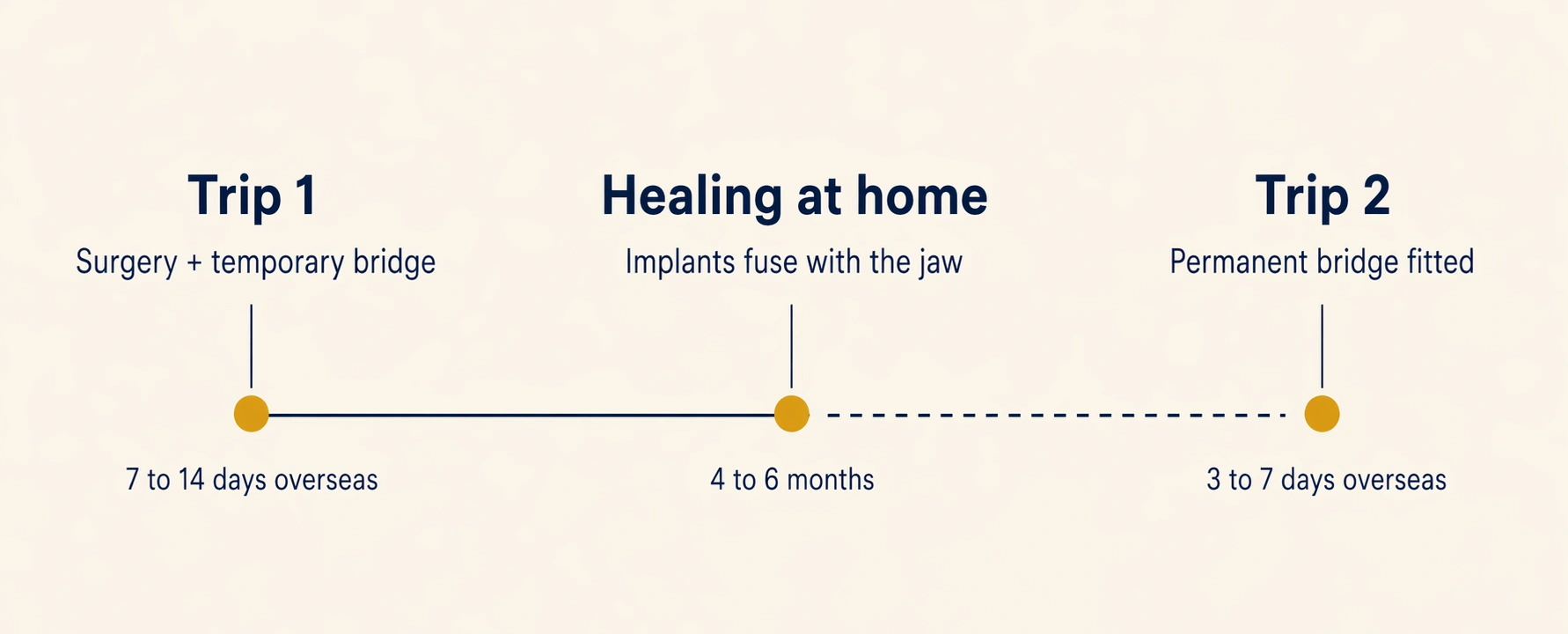
Some Istanbul clinics offer "Teeth in 24 Hours" or same-day All-on-4, where you fly home with a permanent bridge after one visit. It's a legitimate clinical technique for the right patient with the right bone density. Offered as a standard option to avoid a second trip, the compressed timeline increases failure risk. The patients we hear from who've had problems almost always went single-trip. It's the most attractive marketing angle and the most common compromise.
For Turkey specifically, the two-trip reality carries real weight. Two return trips to Istanbul over 12 to 18 months is a meaningful commitment that doesn't apply in the same way to Bangkok or Ho Chi Minh City.
Time off work and hidden extras
You'll need 12 to 18 days off work across two trips. For an average Australian salaried worker, that's $3,000 to $6,000 in lost income if you don't have paid leave banked.
Other costs people don't budget for:
- Travel insurance: $150 to $300 per trip. Standard travel insurance typically excludes elective dental treatment that was the purpose of the trip, and any complications arising from it. Check your policy wording before booking.
- CBCT scan fees (sometimes charged separately): $150 to $400
- Post-operative medication: $50 to $200
A Turkish full-arch with a $9,000 sticker price realistically lands between $15,000 and $20,000 once flights, accommodation, and the second trip are included. Against a premium Australian quote of $35,000, that's still a real saving. Against a competitive Australian quote with financing, the gap narrows considerably.
What happens when something goes wrong?
Will an Australian dentist treat your Istanbul implants?
Many won't. The reasons are practical:
- Liability. If they touch work placed by another dentist overseas, any subsequent failure can be attributed to them.
- Unfamiliar components. If the Istanbul clinic used an off-brand implant, the Australian dentist can't source compatible parts to repair it.
- Uncertainty about what was done. Without complete records, scans, and surgical notes, they're working blind.
The Australian Dental Association (ADA) has a formal policy on this. ADA President Scott Davis has described the kind of post-overseas work Australian dentists see: "crowns that might not fit, might not be the right colour, may not have been cemented properly. Sensitivity, dead nerves, decay left behind, teeth extracted and half the roots left behind."
Premium Istanbul clinics using Straumann or Nobel Biocare give you a better chance of finding an Australian dentist willing to take over maintenance. Budget clinics using off-brand implants often leave you stranded.
Remediation in Australia costs more than most people expect
A failed full-arch case in Australia can cost $15,000 to $50,000+ to remediate, depending on the extent of failure. If the implants themselves fail and the bone has been damaged, the whole treatment has to restart. That means implant removal, bone grafting to rebuild what's lost, and new implants. Costs can match or exceed the original Australian All-on-4 figure ($18,000 to $45,000+).
The ADA has cited one case where a Queensland patient required remedial dental work "in excess of $50,000" after treatment overseas.
Warranties are local unless you ask otherwise
Premium Istanbul clinics often advertise lifetime warranties on the titanium implant fixture and five to ten years on the prosthetic bridge.
The catch is location. Almost all warranties are local-only, meaning the clinic will redo the work in Istanbul at no charge if it fails within the warranty period. They don't cover your return flights ($1,300 to $1,900), accommodation, or any treatment carried out by an Australian dentist. Using that warranty means a 21-to-28-hour return journey. That's not a reason to avoid Turkey, but it's a reason to read the warranty terms before you rely on them.
Before you pay a deposit, ask in writing what the warranty covers, what voids it, and whether any remediation can be arranged through a partner dentist in Australia.
Your formal recourse is in Turkey
The Australian Health Practitioner Regulation Agency (AHPRA) regulates Australian dentists only. An Istanbul clinic isn't under their jurisdiction. If treatment goes wrong, you can't lodge a complaint with AHPRA or the Dental Board of Australia.
Turkey's dental practitioners are licensed by the Turkish Dental Association (TDB) and the Turkish Ministry of Health. Clinics treating international patients are required to hold an International Health Tourism Authorization Certificate from the Ministry. You can cross-check a clinic's authorisation on Turkey's HealthTurkiye portal.
The Smartraveller advisory for Turkey is currently Level 2, “exercise a high degree of caution.” Higher warnings apply to southeastern Turkey near the Syrian border; Istanbul sits within the overall Level 2 rating. Check the page before you travel, as it's updated regularly.
If treatment goes wrong, navigating Turkey's consumer protection system from Australia means doing so in Turkish.
Health funds and Medicare don't cover overseas treatment
Australian private health funds (Bupa, Medibank, HCF, NIB and others) run on HICAPS claiming with Australian provider numbers. Overseas dental treatment sits outside that system. Health funds almost never pay a rebate on overseas procedures.
Travel insurance usually covers emergency dental overseas (acute pain or trauma) but excludes elective work and complications arising from it.
Medicare doesn't cover adult dental in Australia either way. Dental implants are outside Medicare whether the work is done in Sydney or Istanbul. The Net Medical Expenses Tax Offset was abolished in 2019, so there's no general tax break either.
How to evaluate an Istanbul clinic (if you're going)
If you've decided to proceed, here's how to separate a serious clinical operation from a high-volume tourist practice.
Positive signals:
- Named implant brands. Straumann, Nobel Biocare, Neodent, Osstem, or CE-certified European systems like Bego or Bredent. The brand and model should appear in writing in the quote. "European implants" or "premium brands" with no name attached isn't good enough.
- Cone-beam CT (CBCT) imaging on-site. A CBCT scanner produces a 3D map of your jaw and bone density. It's the standard tool for proper implant planning. If a clinic is using flat 2D X-rays only, that's a warning.
- Ministry of Health authorisation for international patients. Turkish clinics treating foreign patients must hold an International Health Tourism Authorization Certificate. Ask for the certificate number and verify it on the HealthTurkiye portal.
- JCI accreditation or ISO 9001 certification. Istanbul has around 29 JCI-accredited hospitals, and JCI accreditation signals a genuine commitment to international quality standards. Standalone dental clinics aren't separately JCI-accredited, but ISO 9001 certification is the common equivalent for dental practices. Confirm which certification the clinic holds.
- TDB registration for the treating dentist. Every practising dentist in Turkey must register with the Turkish Dental Association (TDB). Ask for the treating dentist's TDB registration number, university, and year of graduation. Any reputable clinic provides this without hesitation.
- Published, itemised pricing in USD or EUR. Line-by-line fees for implants, abutments, prosthesis, anaesthesia, and any additional procedures. Pricing in Turkish lira only is a red flag for international patients.
- Written warranty and remediation terms. What the warranty covers, what voids it, and what the process is if something fails.
Questions to ask before you pay a deposit:
- Which exact implant brand and model? What's the warranty, and does it require you to return to Istanbul?
- Who is placing the implant? What's their specific implant training and TDB registration number?
- Is CBCT used for surgical planning?
- What happens if the implant fails at six months, two years, or ten years?
- Will I receive written records, imaging, and surgical notes for my Australian dentist?
- If a complication develops after I fly home, what is your process?
When Turkey makes financial sense (and when it doesn't)
Turkey may make financial sense when:
- You're getting full-arch (All-on-4 or All-on-6), not a single tooth. For single implants, the cost difference rarely survives the flight bill.
- You've modelled the real all-in cost, including two return trips to Istanbul and a contingency.
- You've picked a clinic using Straumann, Nobel Biocare, or another internationally recognised brand with a named model in the quote.
- Your bone structure doesn't need complex grafting.
- You have an Australian dentist willing to handle follow-up maintenance.
- You've looked at Australian financing, and the gap after monthly repayments is still meaningful.
Turkey is higher risk when:
- You have complex bone loss requiring multiple grafting procedures or sinus lifts.
- You can't afford the cost of remediation in Australia if something fails.
- You're looking at a budget clinic with off-brand implants and an acrylic bridge.
- You haven't looked at Australian financing options (superannuation early release, DentiCare, Humm).
- You're planning a single trip for a full-arch to avoid the second return journey.
- You're relying on a warranty that requires you to return to Istanbul to use it — and claiming it means another long-haul journey on top of the two treatment trips.
How to get competitive pricing in Australia
Before booking flights, check what Australian treatment actually costs with financing. The gap might be smaller than the sticker price suggests.
Financing options
DentiCare is an interest-free direct debit plan. Up to $12,000, repaid over 12 months (for treatments under $2,000) or 24 months (for treatments over $2,000). No interest, no complex credit contracts. There's a $39 setup fee, and a 20% deposit is usually required.
Humm is a larger buy-now-pay-later product. Up to $30,000 to $50,000 depending on the clinic. Repayments over 3 to 120 months, with many plans interest-free. You need to be an Australian resident, 18 or older, permanently employed 25 or more hours a week or on a pension, with no prior bankruptcy.
On a $30,000 All-on-4 plan through DentiCare over 24 months, you're looking at around $1,250 per month. That's the real affordability picture most clinic articles skip.
Frequently asked questions
Is it safe to get dental implants in Turkey?
At a premium Istanbul clinic using Straumann or Nobel Biocare, with CBCT planning and properly staged two-trip treatment, outcomes can be good. At a budget clinic on a compressed single-trip timeline, the risk goes up sharply. Before you travel, check the Smartraveller advisory for Turkey. The current rating is Level 2, “exercise a high degree of caution.” Higher warnings apply to southeastern Turkey near the Syrian border; Istanbul sits within the Level 2 rating.
How much do dental implants cost in Turkey compared to Australia?
Full-arch (All-on-4) in Turkey runs $4,500 to $11,000 per arch depending on clinic tier and implant brand. The same treatment in Australia is $18,000 to $45,000+. Turkish figures don't include return flights ($1,300 to $1,900 from Australia's east coast), accommodation, or the second trip for the permanent bridge.
Can an Australian dentist fix Turkey implants if something goes wrong?
Sometimes, and more often if the Istanbul clinic used internationally recognised brands like Straumann, Nobel Biocare, or Osstem. Many Australian dentists decline off-brand overseas work because they can't source compatible parts or verify what was done. Ask your Australian dentist before you fly.
Do Australian health funds cover dental implants done in Turkey?
No. Extras cover runs on HICAPS claiming with Australian provider numbers, and private funds (Bupa, Medibank, HCF, NIB) don't extend rebates to overseas treatment. The ADA has addressed this in Policy 2.2.6.
Is Istanbul the best city in Turkey for dental implants?
For Australian patients, yes. Istanbul has the highest concentration of internationally oriented clinics, more JCI-accredited hospitals than any other city in Turkey, and the best access to English-speaking patient coordinators and experienced implant specialists. Ankara and Izmir both have dental clinics, but the infrastructure for international patients is significantly thinner. If you're flying from Australia, Istanbul is the practical starting point.
Any surgical or invasive procedure carries risks. Before proceeding, seek a second opinion from an appropriately qualified health practitioner.