Dental Implants Cost in Australia: The Complete 2026 Breakdown
Dental implants in Australia cost between $3,000 for a single tooth and up to $90,000 for a full-mouth restoration. Most articles give you that range and stop there. But the variation isn't random. There are specific reasons why two clinics can quote $15,000 apart for what seems like the same procedure.
This guide breaks down what dental implants cost in 2026, what each item on your invoice means, and what your options are for covering the cost.
What do dental implants cost in Australia?
These are the price ranges you’ll see from Australian clinics in 2026. The data comes from published pricing across NSW, VIC, WA, QLD, and SA.
Before you take these as fixed prices, there are three important things to know.
- "From" prices usually leave something out. For full-arch procedures, the most common omission is the final set of teeth. Some clinics quote the surgery and a temporary set only. The final permanent bridge costs an extra $7,000 to $9,000 for acrylic, or $12,000 to $14,000 for zirconia. Two quotes, both listed as "from $19,000", can be $10,000 apart in what they actually deliver.
- Hospital and anaesthetist fees are usually not included. For full-arch procedures done under general anaesthesia, add $2,000 to $5,000.
- Prep work is priced separately. Extractions, bone grafting, and sinus lifts (if required) are not included in most quoted prices. This can add another $1,000 to $8,000, depending on your jaw's condition.
What's actually included in a dental implant quote?
Whether you're replacing one tooth or a full arch, your quote is made up of several separate components. Many clinics bundle them into a single price, which makes it nearly impossible to compare quotes or check what your health fund will cover. Here's what each line item means.

Initial consultation and imaging
Most implant clinics offer a free or low-cost first consultation. The more important question is whether a CBCT (cone beam CT) scan is included. This is a 3D X-ray of your jaw. It costs $200 to $500 if billed separately. It’s the standard of care for implant planning, and any clinic skipping this step is working with incomplete information about your jaw.
Extraction (if required)
Simple extraction: $200 to $350. Surgical extraction: $350 to $550. Some quotes assume you arrive with a gap already. If you have a failing tooth that needs removing, confirm whether the extraction is included in the price you’ve been quoted.
Bone grafting (if required)
If your jaw has lost bone density, grafting is required before or during implant placement. This is one of the most common reasons a quote changes between the first estimate and the final treatment plan.
- Minor socket graft: $500 to $1,200
- Major bone graft: $2,000 to $4,000+ per site
- Sinus lift: $850 to $3,000+ per sinus
Implant fixture
This is the titanium screw placed into the jawbone. Placement typically costs $2,000 to $3,500, including the fixture itself. This is where the implant brand has the biggest impact on the quote.
Abutment
This is the connector piece between the screw and the visible tooth. Fitting costs $500 to $1,200. Some clinics bundle it with the fixture; others price it separately. Both are fine. What matters is that you know which applies to your quote.
Crown (single tooth)
For a single-tooth implant, the crown is the visible tooth placed on top of the abutment. The material used drives a meaningful part of the cost difference between quotes:
- Zirconia (ceramic): $1,600 to $2,500
- PFM (porcelain fused to metal): $1,200 to $2,000
- Acrylic / temporary: $200 to $400
Prosthesis (full arch)
If you're replacing a full arch, you receive a fixed bridge spanning the entire jaw, supported by four to six implants.
This is the component with the largest cost variance in any full-arch quote. It’s also the one most often buried or left out of advertised prices.
The two main material options:
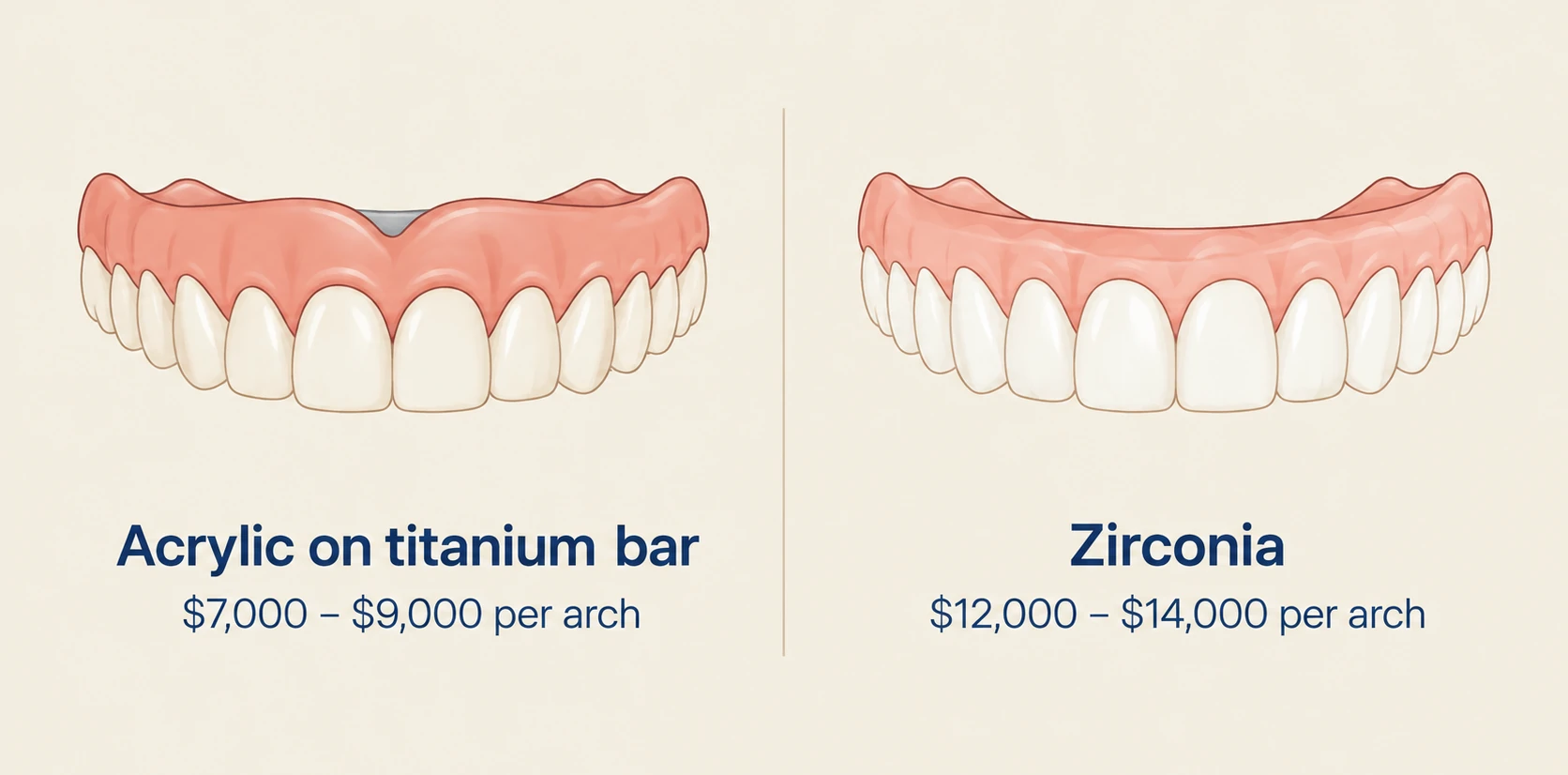
- Acrylic on a titanium bar. The more common starting point. The teeth are made from acrylic resin attached to a metal frame. Functional and good-looking, but less durable over time. Cost per arch: $7,000 to $9,000 for the prosthesis itself. Typically needs replacing every 5 to 10 years.
- Zirconia. A single milled ceramic structure. More durable, easier to clean, and closer in appearance to natural teeth. Cost per arch: $12,000 to $14,000. Lasts longer than acrylic.
When a clinic quotes "from $19,000" for All-on-4, that price almost always includes a temporary acrylic set only. In some cases, there’s no final prosthesis included at all. The zirconia upgrade is priced on top.
Why do two full-arch quotes differ by thousands of dollars?
Let's say you receive two quotes for an All-on-4 procedure. Both describe full-arch implant treatment with a fixed bridge. One is $19,000. The other is $27,000. Here's what's driving that $8,000 gap.
Implant brand
The brand of implant fixture is one of the biggest variables. Australian clinics use implants across four broad tiers:
The fixture costs the clinic roughly $69 to $500, depending on the brand. The fixture itself is a small fraction of what you pay. Surgeon fees, technology, lab work, and practice overheads make up most of the total. But clinics using premium-brand implants tend to price the full procedure at a premium.
Budget-tier Korean implants like Osstem and Dentium are well-tested and widely used worldwide. They’re not inferior by default. What you’re mainly paying for with Premium-tier brands is a longer track record, a stronger warranty, and faster fusing to the jawbone in some cases. An experienced clinician with a mid-range implant will generally outperform a less experienced one with a premium brand.
Prosthesis material
For full-arch implants, the difference between an acrylic and a zirconia prosthesis is $5,000 to $7,000 per arch. That alone can explain a large part of any quote gap. Always confirm what material the quoted prosthesis is made from.
Specialist versus general dentist
Oral surgeons and prosthodontists (specialists in replacing teeth) often charge more than general dentists for the same procedure. The premium is worth it in complex cases: unusual jaw anatomy, significant bone loss, or full-arch reconstructions. For a straightforward single implant in a healthy jaw, an experienced general dentist with a strong implant track record is a reasonable option. The relevant question to ask is how many implants your dentist has placed, not just how long they’ve been in practice.
Location and practice overhead
A clinic in Sydney CBD or Melbourne's inner suburbs has higher rent and higher fees. Regional and suburban clinics regularly offer lower prices for the same quality. On a full-arch case, travelling to a regional centre or interstate can often save more than the cost of flights and accommodation.
How to compare dental implant quotes properly
Getting a few quotes is standard advice. Actually comparing them requires more than looking at the bottom-line number.
Here's what to check across every quote:
Is it itemised? A single price tells you nothing useful. Ask for a line-by-line breakdown with ADA item numbers. These let you check health fund rebates for specific components and make a real comparison across clinics.
What is the implant brand? Get the brand name in writing. "Premium implants" is marketing, not a specification.
What is the prosthesis made of? Acrylic, PFM, or zirconia. For full-arch, confirm whether the quoted prosthesis is the temporary set or the final permanent bridge.
Is the 3D scan included? If not, add $200 to $500.
Are extractions included? Ask whether your specific situation (failing tooth or existing gap) is already accounted for in the quoted price.
Has bone grafting been ruled out? A quote given before a 3D scan is an estimate, not a quote. If the scan later reveals bone loss, the price will change.
What does the warranty cover and for how long? Ask what voids it.
What are the follow-up costs? Some clinics include 12 months of aftercare. Others charge $100 to $200 per visit.
For full-arch: is the final set of teeth included? Or is the quoted price for the surgery and a temporary set only?
Are dental implants covered by Medicare in Australia?
No, with a few exceptions.
Medicare doesn’t cover dental treatment for adults. Medicare classifies dental implants as elective dental procedures. They sit outside the Medicare Benefits Schedule (MBS) entirely.
The Child Dental Benefits Schedule (CDBS) covers eligible children aged 0 to 17 for basic dental services, up to $1,158 over two consecutive calendar years (2026 rate). Dental implants are explicitly excluded from CDBS, regardless of age or circumstance.
There are a few edge cases where some Medicare coverage exists:
DVA Gold Card holders can access all clinically necessary dental services, including implants. Approval must be obtained before treatment starts.
Cleft palate and craniofacial conditions. MBS Category 7 includes 44 item numbers for dental services for eligible patients. Medicare removed age restrictions in November 2023.
Hospital-based oral and maxillofacial surgery. For jaw reconstruction following trauma or oral cancer, Medicare may cover the hospital stay, anaesthesia, and some surgical fees. The implant components themselves are generally not covered, even in these cases.
Does private health insurance cover dental implants?
Yes, partially. For most patients, the rebate is smaller than expected.
What's typically covered
Dental implants fall under Major Dental or Prosthodontics on all major extras policies. These are the approximate annual Major Dental limits for top-tier extras policies at Australia's four largest funds:
These are annual limits. A single dental implant costs $3,000 to $7,000. Even on a top-tier policy, your fund covers roughly 15% to 33% of the total cost. For full-arch treatment at $20,000 to $35,000 per arch, private health insurance covers a very small fraction.
What's usually excluded
Basic and mid-tier extras policies typically exclude Major Dental entirely. Check your Product Disclosure Statement for the precise exclusion list. "Dental cover" in a policy name doesn’t mean Major Dental is included.
What to check before your procedure
Call your fund and give them the ADA item numbers from your itemised quote. Ask specifically: ‘What dollar amount will you pay for each item number?’ Don't just ask, 'Is this covered?' That question only gets you a yes or no.
Other ways to pay for dental implants in Australia
humm / National Dental Plan
The National Dental Plan, run by Centaur and humm, is the most cost-effective option for most patients. It's genuinely interest-free. Not a 0% promotional period that switches to a high rate after 6 months.
- Maximum: $50,000
- Interest: 0%
- Term: 3 to 120 months
To be eligible, you need at least $1,000 per month in taxable income, permanent employment (or an aged or veterans pension), and you must pass a credit check. You need to apply through a participating clinic.
TLC Finance
TLC (Total Lifestyle Credit) is a personal loan broker. It charges interest.
- Loan range: $2,001 to $70,000
- Interest rate: variable, typically 9.4% to 12%
- Term: up to 7 years
- No early payout fees
A $25,000 procedure on TLC at 9.4% over 5 years: roughly $31,380 in total ($523 per month). The lower monthly repayment comes at the cost of $6,380 in interest. TLC suits patients who can’t meet humm's eligibility criteria or need a lower monthly repayment.
DentiCare
DentiCare is an interest-free direct debit plan with a standard cap of $12,000. It’s not suitable as a standalone option for most full-arch procedures. It works well for single-tooth implants. Requires a 20% deposit upfront and runs up to 24 months.
Afterpay and Zip
Standard Afterpay has a spending limit too low for dental implants, typically $500 to $2,000, with a 6-week repayment window. Not suitable.
Zip Money can handle larger amounts, but switches to 25.9% annual interest after any promotional period. At that rate, a $25,000 loan can cost more than $10,000 in interest over a standard repayment period. Not recommended for implant financing unless you can pay it off within the promotional window.
Dental implants vs. other tooth replacement options
The upfront comparison is misleading without accounting for two things: the ongoing cost of replacing alternatives, and the jawbone loss that alternatives speed up.
A traditional bridge involves cutting down the healthy teeth on either side. It needs replacing every 7 to 15 years. Dentures need regular relining and eventually need to be remade. They also speed up the bone loss in your jaw, which makes future treatment more complicated and expensive.
Studies show dental implants have a 96.4% survival rate at 10 years. It also preserves the jawbone that would otherwise shrink over time.
All-on-4 isn’t necessarily more expensive over 20 years than repeated denture replacement and the bone treatments that come with it. The upfront cost is higher. But the 20-year picture is often much closer than the initial numbers suggest.
Red flags in a dental implant quote
These are not guarantees of a bad outcome. They are patterns that warrant more questions before you commit.
No 3D scan in the treatment plan. 3D imaging is the standard of care for implant planning. A clinic skipping this step is either under-equipped or cutting costs.
No implant brand specified. "Premium quality implants" without a brand name is marketing language. Ask directly and get the answer in writing.
No itemised breakdown. A single-total quote doesn’t give you what you need to compare it accurately, check health fund rebates, or understand what you’re agreeing to.
Pressure to commit on the day. "This price is only available today" is a sales tactic. Implant treatment is a multi-month process involving surgery. Any clinic that can’t give you time to think it over isn’t treating the decision with appropriate seriousness.
No mention of bone density. A quote given before a 3D scan is a rough estimate. If the scan later reveals bone loss, the final cost will be higher than what you were first told. Ask directly: "Is this quote based on my bone density being adequate? And what happens to the price if it’s not?"
Frequently asked questions
How long do dental implants last?
Implant fixtures have a 96.4% survival rate at 10 years. Many can last 20 to 30 years. The crown or prosthesis on top typically needs replacing every 10 to 15 years. Full-arch acrylic prostheses generally need replacement every 5 to 10 years, depending on wear. Zirconia lasts longer.
Is it cheaper to get dental implants overseas?
Thailand, Bali, and similar destinations offer prices 40% to 70% lower than Australian rates. The trade-offs include warranty enforcement if something goes wrong, continuity of care, and the cost of follow-up travel. A single straightforward implant is more viable as a dental travel option than a full-arch procedure, which requires many visits across 6 to 12 months. One unplanned return trip for a complication can wipe out most of the savings.
How long does the implant process take from start to finish?
For most full-arch patients, the process takes 3 to 6 months from surgery to final teeth. Cases that need bone grafting or a sinus lift take longer, sometimes up to 12 to 15 months in total.
The good news is that most patients don't leave surgery without teeth. With All-on-4, you can walk out the same day with a functioning arch. The final permanent teeth are fitted 3 to 6 months later, once the implants have fully fused to the jaw.
Not everyone qualifies for that timeline. Cases requiring bone grafting add 3 to 6 months before implant placement can begin. Sinus lifts (needed when there's not enough bone height in the upper jaw) can add 4 to 9 months. The more work required, the longer the timeline.
Is All-on-4 right for me if I still have some teeth?
It depends on the condition of those remaining teeth. In some cases, removing failing teeth and replacing the full arch is more cost-effective and clinically sound than trying to preserve them. This is a decision that requires proper assessment, including a 3D scan and a thorough examination by someone who specialises in full-arch dental implants.
A note on pricing data
Pricing data comes from ImplantBridge's review of Australian dental implant clinic pricing and current ADA fee schedules, conducted in March 2026. Government and regulatory information was sourced directly from the ATO, Services Australia, and AHPRA. Prices are indicative and subject to change. Always request an itemised quote from your treating clinician before making any decisions.