

Tooth Replacement Options in Australia: 2026 Cost Guide

You've lost a tooth, or several, or you're facing the loss of a whole arch, and now you have to decide what to do. A dentist might have mentioned implants, a bridge, or a denture. Or you've started searching and found prices that swing by thousands of dollars with no clear explanation.
ImplantBridge helps Australians work through implant and full-arch treatment. We spend our days talking to people going through this exact decision, and to the clinics that treat them.
Why replace a missing tooth
What a gap does to your mouth
When a tooth comes out, the bone that held its root starts to shrink. Bone stays strong when it's used. Every time you chew, pressure runs down through the tooth into the jaw, and that pressure tells your body to keep the bone there. Remove the tooth, and the pressure stops, so the body slowly takes the bone back. The ridge gets lower and thinner over months and years.
The teeth around the gap shift too. Teeth lean and slide toward an empty space. The tooth in the opposite jaw, with nothing to bite against, can drift out of line. Your bite changes, which can make chewing harder and wear some teeth faster. Missing teeth can also change speech and the shape of your face. Front teeth help form certain sounds, and losing back teeth on both sides over the years can make the lower face look shorter.
Waiting has a price, too. The longer a gap sits, the more bone you lose. If you choose an implant later, too little bone can mean a graft first, adding cost and months of healing.
How long can you wait?
A short wait is normal. After an extraction, the site needs weeks to heal before some treatments can begin. If your budget is tight, taking a few months to plan and save is sensible. Waiting years is a different thing. Bone keeps shrinking, the nearby teeth keep drifting, and whatever treatment you choose later ends up more complex and expensive.
The main tooth replacement options
Dental implants
A dental implant is a small titanium post placed into your jawbone. It works as an artificial tooth root. Over about three to six months, the bone grows around it and locks it in place, and a crown, the visible false tooth, goes on top. One implant can hold one crown. A few implants can carry a bridge or a full set of teeth.
Implants are the only option that replaces the root, so they're the only option that keeps the jawbone working and slows the shrinking. They don't touch the teeth on either side of the gap. A single implant has a high success rate (above 90% over ten years), and the post can last decades. The crown on top may need replacing later, often after 15 to 25 years.
An implant costs the most up front. It needs minor surgery and several months of healing. For a single tooth, an implant in Australia generally costs $3,000 to $6,500, covering the post, the connector and the crown. Full-arch dental implants are a much bigger job, generally $25,000 to $45,000 per arch.
Dental bridges
A bridge fills a gap by hanging a false tooth between the two teeth on either side. The dentist files down those neighbouring teeth and caps each one with a crown. The false tooth in the middle, called a pontic, is joined to those crowns, and the whole piece is cemented in. A standard bridge for one missing tooth has three parts: two crowns and one pontic.
A bridge is fixed and stable. It looks natural, brings back normal chewing, costs less up front than an implant, needs no surgery, and is usually finished within a few weeks. The trade-off is the two healthy teeth. To carry the bridge, the dentist removes enamel from teeth that might have had nothing wrong with them, and those teeth stay crowned for good. If one of them later runs into trouble, the whole bridge can be affected. A bridge also does nothing for the bone under the gap, since there's no root. Most bridges last 10 to 15 years, then need redoing. A three-unit bridge usually costs $3,000 to $7,000.
Dentures
A denture is a removable plate of false teeth. A partial denture replaces a few missing teeth and clips onto the natural teeth you still have. A full denture replaces every tooth in one jaw, the upper or the lower, and rests on the gum.
Dentures are the lowest-cost way to replace several teeth or a whole arch. They don’t need surgery, can be made fairly quickly, and a partial can be adjusted if you lose more teeth later. They also carry the most day-to-day downsides. A denture comes out, so it can move while you eat or talk, and a lower full denture is the hardest to keep steady. A full upper denture covers part of the roof of the mouth, which can dull taste. A denture doesn't slow bone loss, so as the bone shrinks underneath, the fit loosens. Dentures need occasional relines (a refit of the base) and replacement every 5 to 10 years. A full denture usually costs $1,800 to $3,500 per arch, and a partial denture costs $700 to $3,000.
The options at a glance
These are indicative ranges, not quotes. Prices change with the clinic, materials, city, and how complex your case is.
Up-front price versus lifetime cost
Why cheaper can cost more
Implants cost the most on day one, but the post is built to stay. Dentures and bridges cost less on day one but have to be redone later. A bridge lasts around 10 to 15 years. A denture lasts around 5 to 10 years, and needs relines in between. So the real question is how many times you'll pay for it, not just what it costs once.
A worked example
Picture someone aged 55 replacing one tooth.
- An implant might cost $5,000 now. The crown could need replacing once more across the next 30 years, say $2,000. Rough total: about $7,000.
- A bridge might cost $4,500 now. Bridges last 10 to 15 years, so over 30 years, you'd likely be on your third one. Rough total: about $13,500, and each redo can mean more work on the supporting teeth.
- A partial denture might cost $1,500 now. With relines along the way and replacement every 5 to 10 years, 30 years could mean four or five dentures. Rough total: somewhere around $8,000 to $10,000.
Lifetime cost isn't the only thing that counts, though. If an implant is out of reach right now, a denture you can actually afford beats a gap you leave for years while you save.
Replacing a full arch
If you've lost most or all of the teeth in a jaw, or you're heading that way, this part is for you. Rebuilding a whole arch works differently from filling a single gap.
About 1 in 25 Australian adults have lost all their natural teeth, and that climbs to roughly 1 in 7 by age 65, according to the Australian Institute of Health and Welfare. For a full arch, a traditional bridge usually isn't an option, because a bridge needs natural teeth to anchor to. So the choice narrows to a full denture or a full arch held by implants.
Fixed teeth: All-on-4 and All-on-6
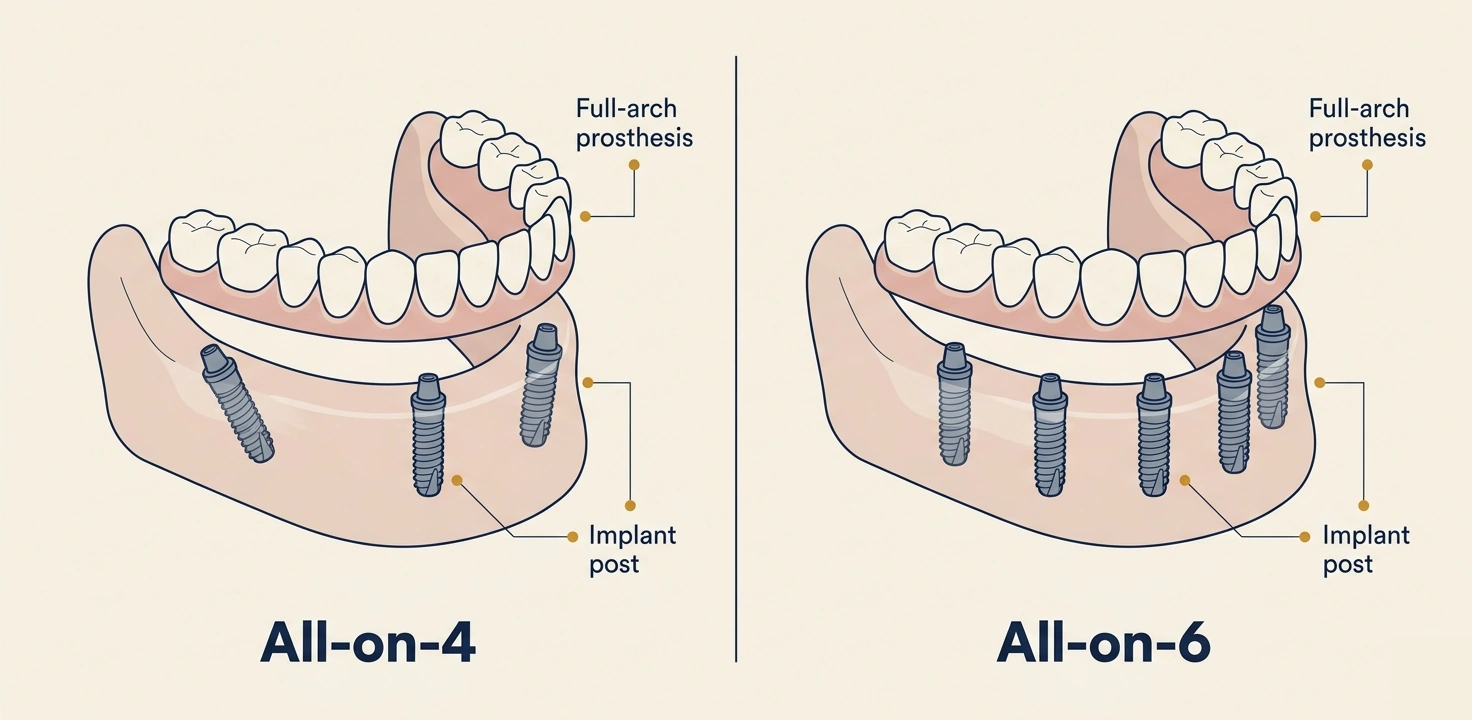
You don't need one implant for every missing tooth. A whole arch of teeth can sit on just four or six implants, which is where the names All-on-4 and All-on-6 come from. The surgeon places four or six posts into the jaw, often angled to use the bone you have, and a full set of teeth is fixed on top. The result is a set of teeth that stays put. You don't take it out at night, and it doesn't rock when you chew. Because the implants sit in the bone, they keep the bone active, the way natural roots do.
Our guide to how dental implants work covers the process in more detail.
Implant-supported denture
An implant-supported denture, sometimes called an overdenture, clips onto two or more implants. You still take it out to clean, but it's far steadier than an ordinary denture because the implants hold it down. It costs less than a fixed arch and sits between a standard denture and fixed teeth.
What full-arch treatment costs
Full-arch treatment is the biggest spend of any option here, and the range is wide. A fixed arch on four implants generally costs $25,000 to $45,000 per arch. An implant-supported denture that clips onto a couple of implants is cheaper, often $9,000 to $15,000 per arch. Doing both jaws roughly doubles the figure, so a full mouth of fixed implant teeth can land anywhere from $46,000 to $90,000.
What moves the price: how many implants you need, the material of the teeth, whether teeth have to come out first, whether bone has to be built up, and the experience of the clinician. A quote that looks low next to the others may simply have left some of that out.
Set against this, a full denture is far cheaper to start, usually $1,800 to $3,500 per arch. It’s cheaper to start, but it gets relined and replaced over the years, so the cost gap narrows. Many people do well with a full denture. Others find that a lower denture never feels secure, and a fixed result on implants solves that. The right one depends on your bone, your budget, and how much a stable, fixed result is worth to you.
Who each option suits
What affects implant eligibility
An implant needs enough healthy bone to hold it and healthy gums around it. The main things a dentist checks:
- Bone. There has to be enough bone, in height and width, at the site. Bone shrinks after tooth loss, so a gap that's sat empty for years may have less to offer.
- Gum health. Active gum disease, an infection of the gum and bone around the teeth, has to be treated and settled first. People with a treated, stable history of gum disease can still be candidates.
- General health. Placing an implant is a minor surgery, so you need to be well enough to heal. Uncontrolled diabetes, certain osteoporosis medications, blood thinners, and past radiation to the head or neck all need to be talked through. Most well-managed conditions are fine.
- Smoking. Smoking raises the risk of an implant failing. Smoking roughly doubles the risk of an implant failing. Smokers can still have implants, and many do well, but dentists usually ask you to stop for a week before surgery and several weeks after.
Borderline cases and bone grafting
Plenty of patients aren't a clear yes or a clear no. They sit in between, and the usual reason is bone. There isn't quite enough to hold an implant safely.
Bone grafting is the answer to that. A graft rebuilds the bone so an implant can go in later. It adds cost, often $500 to $3,000, and months of healing. A sinus lift does a similar job in the upper back jaw. For upper jaws with very little bone, there are longer implants anchored in the cheekbone, called zygomatic implants, though that's specialist work.
When a bridge or denture suits better
Implants aren't the right call for everyone, and a good dentist will say so plainly. A bridge can be the better choice when the teeth on either side of the gap already need crowns anyway, or when you want a fixed tooth without surgery. A denture can be the better choice in a few situations: when teeth are missing in several spots, when the bone is too poor for implants and you don't want grafting, or when budget rules the others out. A well-made denture is a sensible solution for a great many people, not a consolation prize.
How to pay for it
Medicare
Medicare doesn't cover implants, bridges or dentures for adults. General and cosmetic dental treatment falls outside the Medicare Benefits Schedule. There's a narrow exception for treatment that's medically necessary and done in a hospital, for instance, after a serious accident.
Private health insurance
Implants, bridges and dentures fall under "Major Dental," part of the extras side of private health cover. A few things shape what you actually get back:
- Waiting period. Major Dental usually carries a 12-month wait after you join or upgrade a policy. You can't take out cover today and claim an implant next month.
- Annual limit. Most extras policies cap dental at somewhere around $1,000 to $2,500 a year for everything combined. Some funds set a separate, lower limit just for implants.
- What comes back. A rebate on a single implant is often $1,500 to $2,500 in total. Cover rarely pays even half of a full-arch case, and some funds pay only for the crown, not the surgery.
Public dental and other help
About 1 in 3 Australians can use the public dental system, generally concession-card holders. It can help with dentures and basic care, though it rarely funds implants. Waits for routine care range from months to a couple of years, depending on the state.
Eligible veterans with a Department of Veterans' Affairs Gold Card can get dental care, including dentures, through the DVA. More involved treatment, such as implants, generally needs prior approval, so check before you assume it's covered.
Many clinics offer payment plans that spread treatment over months, often interest-free for a set period. These usually run through the clinic or a third-party provider, so check the fees and what the interest rate becomes after any interest-free period.
How to choose the option that fits you
The right option comes down to a handful of honest questions.
How many teeth are you replacing? One tooth in an otherwise healthy mouth points toward an implant or a bridge. If you're replacing several teeth or a whole arch, a denture or implant-supported teeth make more sense.
What's your bone and gum health like? Good bone and healthy gums keep every option open. Significant bone loss narrows the list, unless you're willing to have grafting done first.
What's your budget, and over what time frame? If you can plan over years, the lifetime maths leans toward implants. If the lowest cost right now is what matters, a denture or a bridge does the job.
How much does a fixed, stable result matter to you? Some people are perfectly comfortable with something removable. Others never settle for a denture that moves, and for them, a fixed result earns its cost and its surgery.
Frequently asked questions
What's the cheapest way to replace a missing tooth?
For a single tooth, a dental flipper is usually the cheapest thing a dentist can make, around $900 to $1,500, but it's a short-term fix. A partial denture is the cheapest option, built to last. Keep the lifetime cost in mind: the cheapest choice today often costs more over the years, because dentures and bridges get replaced while an implant usually doesn't.
Can you leave a missing tooth untreated?
You can, and some people do, but a gap has consequences. The bone beneath it shrinks, the teeth around it drift, and your bite shifts. A long gap also makes a future implant harder, because there's less bone left to work with. A short wait is fine, but years of waiting carry a real cost.
How long do implants, bridges and dentures last?
An implant post can last decades, often a lifetime, though the crown on top may need replacing after 15 to 25 years. A bridge usually lasts 10 to 15 years. Dentures last about 5 to 10 years and need relines along the way as the jaw changes shape.
Is a bridge cheaper than an implant?
Up front, usually yes, though they can be close. A three-unit bridge often costs $3,000 to $7,000, and a single implant costs $3,000 to $6,500. Over 20 or 30 years, a bridge often costs more because it gets replaced 2 or 3 times, while an implant usually doesn't. A bridge also means filing down two healthy teeth.
Does Medicare cover any tooth replacement?
No. Medicare doesn't cover implants, bridges or dentures for adults. The only exceptions are rare cases of medically necessary, hospital-based treatment. Private health extras with Major Dental cover can give a partial rebate, and concession card holders may be able to use public dental services.
What's the best option for a single front tooth?
A front tooth is about appearance as much as function. An implant usually gives the most natural result and leaves the neighbouring teeth untouched. A bridge can look good too, but it means crowning the teeth on either side. A denture or flipper can fill the gap while you decide. The right pick depends on your bone, your budget and your timing.
How long does the whole process take?
A single implant usually takes three to six months from placement to the final crown, because the bone needs time to grow around the post. A bone graft adds several more months. A bridge or denture is quicker, often a few weeks. Full-arch implant treatment varies, and some clinics fit a temporary set of teeth on the day of surgery.
Can you replace a full set of teeth with implants?
Yes. A whole arch of teeth can sit on four or six implants, often called All-on-4 or All-on-6. The teeth can be fixed in place, or made as a denture that clips onto the implants and is far steadier than an ordinary one. It's the biggest spend of any option, generally $25,000 to $45,000 per arch.
Any surgical or invasive procedure carries risks. Before proceeding, seek a second opinion from an appropriately qualified health practitioner.
