
Implant-Supported Dentures in Australia: Costs and Types
If your denture moves when you eat, or you've been told your remaining teeth can't be saved, implant-supported dentures are one of the options you'll be weighing up. They use dental implants to hold a denture firmly in place, so it doesn't slip, click or rub against your gums.
Most people who come to ImplantBridge are weighing a full arch. We give them all the same honest answer: it depends on your jaw, your budget, and how much trouble your denture is causing you. For some people, they're worth every dollar. For others, a well-made standard denture does the same job for far less.
What are implant-supported dentures?
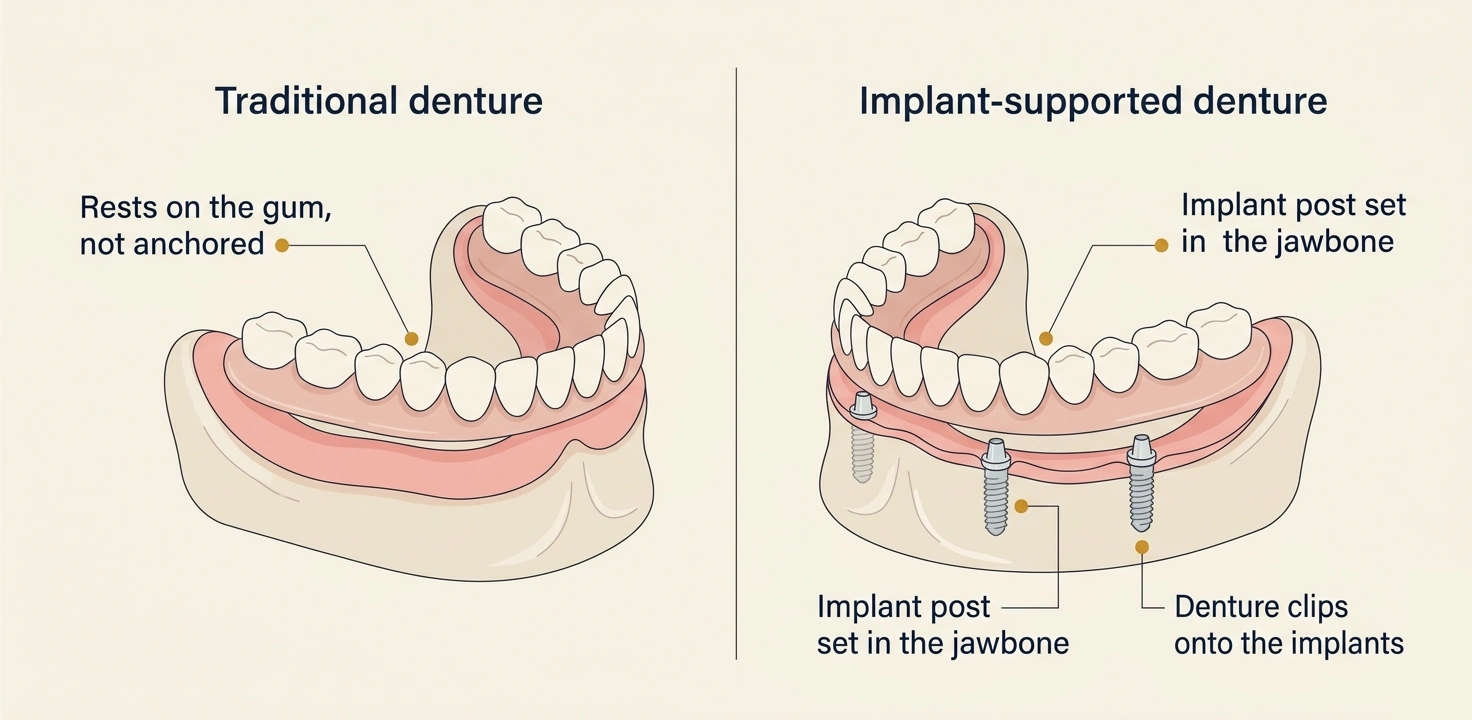
An implant-supported denture is a full denture that attaches to implants set into your jaw. A standard denture sits on top of your gums and stays in through suction and fit. An implant-supported denture connects to small posts in the bone, so it's held from below.
The posts are the dental implants. Each one is a small screw, usually titanium, placed where a tooth root used to be. The bone grows around it and locks it in. The denture then clips or screws onto those posts.
You'll see this treatment called several things: denture implants, implant dentures, permanent dentures on implants, or overdentures. They all mean the same thing.
Implant-supported dentures vs traditional dentures
A standard denture is removable, cheaper, and doesn’t need surgery. A lower one often moves around, because there's less bone ridge to grip. Many people manage well with an upper denture but struggle with the lower.
An implant-supported denture is held firmly. It stays put when you chew, talk and laugh, and you can eat a wider range of foods. The implants also press load into the jaw the way tooth roots once did. That slows the bone loss that causes plain dentures to loosen over the years.
The main types of implant denture
Implant-supported dentures aren't one treatment. The first question is whether the denture is removable, so you take it out yourself, or fixed, so only your dentist can. That choice drives the cost and daily care.
Snap-in overdentures
This is the most common starting point. Two implants are placed in the lower jaw near the front. The denture has matching attachments that click onto it, which is why it's often called a snap-in or snap-on denture.
The implants stop the denture from lifting and sliding. Your gums still carry some of the chewing load. You take the denture out to clean it, and at night. It's used mostly for the lower jaw, where standard dentures cause the most grief, and it's the cheapest way into implant treatment.
Bar-retained overdentures
A metal bar joins several implants, usually four, across the arch. The denture clips onto the bar. It's still removable, but it's held more firmly than a two-implant snap-in, and more of the load sits on the implants rather than the gums. This suits people who want a removable denture with more grip than two implants can give.
Fixed dentures and All-on-4
A fixed implant denture is screwed onto the implants and stays in. You don't take it out. You clean around and under it, and your dentist removes it now and then for a check.
All-on-4 is the name you'll hear most. It's a fixed full-arch denture on four implants. All-on-6 uses six. All-on-4 is a type of fixed denture, not a separate category. Some people call the fixed option permanent dentures on implants, or a hybrid.
It's worth a quick word on the names. The terms implant-retained and implant-supported get used loosely, even by clinics, and sometimes mean the same thing. The distinction that matters is whether the denture is removable or fixed, and how much of the chewing the implants do.
What implant-supported dentures cost in Australia
The figures below are from ImplantBridge's review of the Australian market. Your cost depends on the type, the number of implants, your jaw, and where you're treated.
Costs by type
A fixed full arch is the big spend. Entry pricing starts near $18,000, and complex cases or premium materials can pass $45,000.
Low full-arch quotes need a close read. Many cover only the temporary teeth fitted on surgery day, and the final, stronger set is priced separately, adding $4,000 to $20,000. Always ask whether the quote includes the final teeth.
The costs people forget
The headline price isn't the whole bill. Before treatment, you may need:
- An initial consult: free at some clinics, up to about $250 at others.
- A 3D scan of your jaw, called a CBCT scan: roughly $200 to $500.
- Tooth extractions: about $150 to $350 for a simple one, more if it's surgical.
- A bone graft, if there isn't enough bone to hold the implants: $500 to $8,000, depending on how much is needed.
There are ongoing costs, too. A removable overdenture needs relines, where the fitting surface is rebuilt as your gums change shape. This costs roughly $250 to $600 every 1 to 3 years.
Why quotes can differ by thousands
Three quotes for the same treatment usually won't match, and the gap can run to thousands of dollars. The gap usually comes from the implant brand, the surgeon, the materials, and the clinic's location. A cheaper quote isn't always worse. But a quote that leaves out the scan, the grafting or the final teeth isn't comparable.
For city-by-city pricing, see our cost guides: Melbourne, Sydney, Brisbane, Adelaide, Perth, and Gold Coast.
Paying for treatment
Medicare
Medicare doesn't cover dental implants for adults. It treats them as elective dental treatment, outside the Medicare schedule. The Child Dental Benefits Schedule covers some basic dental services for eligible children up to age 17, but not implants. You can check what it covers on the Services Australia website. Public dental services exist for concession card holders, though waiting lists are long and implants are rarely offered.
Private health insurance
If you hold extras cover with Major Dental, you may get a partial rebate. Don't expect it to stretch far. Annual limits reset each year and don't roll over, and Major Dental usually has a 12-month waiting period. Some people time their treatment across two calendar years to use two years of limits. Check your own policy, and ask for the item numbers so you can confirm what's covered.
The treatment process, step by step
From the first consultation to the final teeth, a straightforward case takes about 4 to 6 months, most of which is healing time.
Assessment and planning
Your dentist examines your mouth and takes a 3D scan of your jaw. The scan shows how much bone you have and where the nerves sit. This is where they decide how many implants you need and whether you need any groundwork first.
Groundwork, if needed
Failing teeth are removed. If your jaw has lost too much bone, you may need a bone graft to rebuild it, which adds healing time before the implants can go in. The All-on-4 method angles the rear implants to use more of the bone you already have, so many people can skip grafting.
Placing the implants
The implants are placed into the jawbone, usually under local anaesthetic. Sedation is available if you want it. This is day surgery, and you go home the same day.
Healing
The implants need time to fuse with the bone, a process called osseointegration. It takes about 3 to 6 months. You wear a temporary denture during this time, so you're not without teeth. With a fixed full arch, many people leave surgery the same day with a temporary fixed set, often called same-day or immediate-load teeth.
Fitting the final denture
Once the implants have fused, your dentist takes impressions, and the final denture is made and fitted.
Are implant-supported dentures right for you?
What you need
You need enough jawbone to hold the implants, or enough that a graft can rebuild. You need healthy gums, so active gum disease is treated first. General health matters too. Heavy smoking and poorly controlled diabetes both raise the risk of an implant failing, and so does grinding your teeth at night without a guard. Age on its own isn't a barrier. Plenty of people in their seventies and eighties do well.
Who they suit best
The clearest case is a loose lower denture that won't stay put, no matter what you try. A snap-in overdenture can change daily life for those people. If you've lost all the teeth in an arch, or you're about to, a fixed full arch gives you a stable set that feels close to natural teeth.
When a standard denture is better
If your current dentures fit well and you're comfortable, the case for spending $20,000 or $30,000 is weak. If your budget is tight and surgery worries you, a well-made standard denture is a sound choice that millions of people live with happily. Implant treatment also requires ongoing maintenance and regular dental visits. If that doesn't suit you, it's better to know now.
Care and how long they last
Daily care
A removable overdenture comes out for cleaning. You brush it, brush your gums and tongue, and clean the attachments. A fixed denture stays in. You brush it like natural teeth and clean underneath it with a floss threader or a small interdental brush.
How long they last
Online advice on this contradicts itself, because the parts wear out at different rates.
The implants themselves can last a very long time. Studies put 10-year survival at around 90 to 95%, and they can last decades.
The denture or bridge on top wears faster. An acrylic set may need replacing every 5 to 10 years. A zirconia bridge often lasts 10 to 15 years. A removable overdenture base usually falls somewhere in the 5 to 15-year range.
The small parts wear fastest, with relines every 1 to 3 years and clip inserts every 6 to 18 months.
Frequently asked questions
Are implant-supported dentures worth it?
For people whose dentures slip and rub, they often are. They restore stable chewing and remove the daily worry of a denture moving. Whether they're worth it for you depends on your budget and how much trouble your current teeth give you. If your dentures already fit well, the case is weaker.
Can you eat normally with implant-supported dentures?
You can eat a much wider range of foods than with a standard denture, including firmer foods that loose dentures can't handle. After surgery, you start on soft foods while the implants heal, then build back up. A fixed full arch gives the closest result to natural chewing.
Do implant-supported dentures come out?
It depends on the type. A snap-in or bar-retained overdenture is removable, so you take it out to clean and at night. A fixed implant denture stays in, and only your dentist can remove it.
How many implants do you need for a denture?
A removable snap-in overdenture usually uses two implants, most often in the lower jaw. A fixed full-arch denture usually uses four to six. The right number depends on your jaw, your bite and the type of denture.
Is getting implant-supported dentures painful?
The implants are placed under local anaesthetic, so you shouldn't feel pain during surgery. Sedation is available if you're anxious. Afterwards, most people have some swelling and soreness for a few days, managed with ordinary pain relief.
How long does the whole process take?
For a straightforward case, around 4 to 6 months from the first consultation to the final teeth. Most of that is the healing time the implants need to fuse with the bone. Extractions or grafting can push it to a year or more.
Any surgical or invasive procedure carries risks. Before proceeding, seek a second opinion from an appropriately qualified health practitioner.