Dental Implants Vietnam vs Australia: The Honest 2026 Guide

You're looking at a $30,000 quote for full-arch dental implants in Australia. Ho Chi Minh City clinics are advertising the same work for around $8,000. You want to know if it's worth the risk.
We speak to full-arch patients every week who've got an Australian quote, flinch at the number, and start searching Vietnam packages the same night. If that's where you are, this guide is for your situation.
Why Australians look to Vietnam for dental implants
A full arch (a complete set of top or bottom teeth, usually replaced with All-on-4 or All-on-6) in Ho Chi Minh City (HCMC) is $6,000 to $11,000 at a premium clinic. The same arch in Australia costs $30,000 to $45,000 at a premium clinic. The gap can sit between $15,000 and $30,000. That's why Australians keep flying there.
Vietnam is the most affordable dental tourism destination in Southeast Asia. It doesn't have Thailand's depth of medical tourism infrastructure, but Ho Chi Minh City has a growing cluster of internationally oriented dental clinics that treat Australian patients each year.
Premium HCMC clinics targeting international patients have English-speaking staff and dedicated coordinators. Mid-tier and local clinics often don't. That gap is a quality signal, not just a convenience.
Australians already make up the majority of foreign clients at some Vietnamese clinics, and the country's Ministry of Health lists them among the top nationalities receiving treatment there.
If you want the broader picture across Bali, Thailand and other destinations, read our guide on dental implants overseas.
The real cost of dental implants: Vietnam vs Australia
Full-arch pricing (All-on-4 and All-on-6)
All figures AUD, 2026.
Budget Vietnamese clinics often use Korean or generic implant systems. These can work in the short term, but they have less long-term clinical data than the major Swiss and Swedish brands. If something goes wrong years later, an Australian dentist often can't source compatible parts to repair them.
Premium HCMC clinics use Straumann, Nobel Biocare, Neodent (Straumann-owned) or Osstem. Straumann and Nobel Biocare are registered with the Therapeutic Goods Administration in Australia. That matters later if you need maintenance or repair.
Korean brands, Dentium and MegaGen in particular, are also common at mid-tier to premium Vietnamese clinics. Both have Australian distributors, so compatible components can in principle be sourced here. They're less familiar to Australian practitioners than Straumann or Nobel Biocare, which makes aftercare possible but less seamless.
Why quotes vary so widely
Three main things drive the price:
- Implant brand. Generic systems cost a fraction of Straumann or Nobel Biocare.
- Prosthetic material. An acrylic bridge costs $3,000 to $5,000 less than zirconia, per arch.
- Whether bone work is needed. Grafting or sinus lifts add $1,000 to $5,000 in Australia, or $200 to $1,000 in Vietnam.
Some Vietnamese clinics advertise 70–80% savings without showing what a full arch actually costs. The savings only matter if you know whether it's a budget or premium clinic, which implant brand, and what's included.
The costs that don't show up in the quote
Flights, accommodation and transport
Return economy flights from Sydney, Melbourne or Brisbane to Ho Chi Minh City are $400 to $700 in off-peak months. Peak Christmas and school holiday pricing roughly doubles that. Direct flight time is around 8.5 to 9 hours.
Mid-range accommodation in District 1 or District 3 (the areas most dental tourists stay in) costs $55 to $100 per night. For a 10-day trip, that's $550 to $1,000. Add meals, local transport and incidentals at $30 to $60 a day. On-the-ground costs in Ho Chi Minh City run cheaper than Bangkok.
The two-trip reality for full-arch
Full-arch implants need osseointegration, which is the 4 to 6 months it takes for the bone to fuse with the titanium implant. This process can't be rushed. Properly staged treatment looks like this:
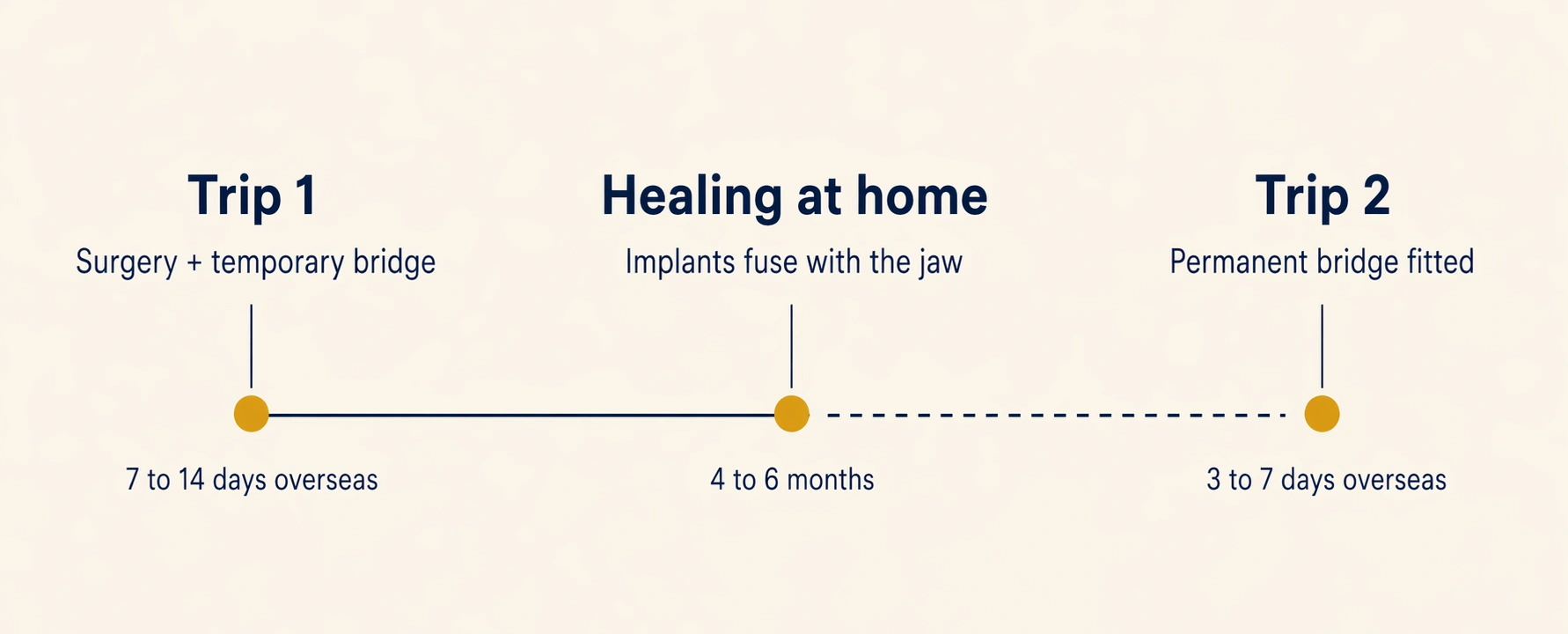
Some Ho Chi Minh City clinics offer 'Teeth in 24 Hours' or 'Same Day All-on-4', where you fly home with a permanent bridge after one visit. It's a legitimate clinical technique for the right patient with the right bone density. Offered as standard to avoid a second trip, the compressed timeline increases the risk of failure.
The patients we hear from who've had problems almost always went for single-trip treatment. It's the most attractive marketing angle and the most common compromise.
Scott Davis, a consultant prosthodontist and Australian Dental Association spokesperson, told the ABC he regularly sees complications from compressed timelines. Patients try to fit three to six months of healing into a two-week trip, and as he put it, "biology just doesn't listen to that."
Time off work and hidden extras
You'll need 12 to 18 days off work across two trips. For an average Australian salaried worker, that's $3,000 to $6,000 in lost income if you don't have paid leave banked.
Other extras people don't budget for:
- Travel insurance: $150 to $300 per trip
- CBCT scan fees (sometimes charged on top): $150 to $400
- Post-operative medication: $50 to $200
A Vietnamese full-arch implant with a $9,000 sticker price realistically lands between $13,000 and $18,000 once you add everything up. Against a premium Australian quote of $35,000, that's still a real saving. Against a competitive Australian quote of $28,000 with financing, the gap narrows significantly.
What happens when something goes wrong?
Will an Australian dentist treat your Vietnam implants?
Many won't. The reasons are practical:
- Liability. If they touch work placed by another dentist overseas, any failure can be pinned on them.
- Unfamiliar components. If the Vietnamese clinic used an off-brand implant, the Australian dentist can't source matching abutments or crowns.
- Uncertainty about what was done. Without complete records, radiographs and surgical notes, they're working blind.
The Australian Dental Association (ADA) has a formal policy on this. Consultant prosthodontist and ADA spokesperson Scott Davis has publicly described the kind of post-overseas work Australian dentists see: "crowns that might not fit, might not be the right colour, may not have been cemented properly. Sensitivity, dead nerves, decay left behind, teeth extracted and half the roots left behind."
Premium clinics using Straumann, Nobel Biocare or well-distributed Korean brands give you a better chance of finding an Australian dentist willing to take over maintenance. Budget clinics using off-brand implants often leave you stranded.
Remediation costs in Australia
A failed full-arch case in Australia can cost $15,000 to $50,000+ to remediate, depending on the extent of failure. If the implants themselves fail and the bone has been damaged, the whole treatment has to restart. That means implant removal, bone grafting to rebuild what's lost, and new implants. Costs can match or exceed the original Australian All-on-4 figure ($18,000 to $45,000+).
The ADA has cited one case where a Queensland patient required remedial dental work "in excess of $50,000" after treatment overseas.
Warranties are local-only
Warranty terms vary a lot by clinic tier in Vietnam. Budget clinics typically offer 1 to 3 years on the implant fixture. Premium clinics targeting international patients tend to offer 5- to 10-year written warranties on the fixture. Read the terms carefully regardless of the number.
A review of warranty terms from Vietnamese clinics targeting international patients shows these are almost always local-only. The warranty entitles you to a replacement, but it's handled in Ho Chi Minh City. It doesn't cover return travel, accommodation, or any treatment performed by an Australian dentist. The warranty is also typically void if any other dentist modifies the work.
A warranty on a $9,000 All-on-4 means the clinic will redo the work for free if it fails. You'll fly back to Ho Chi Minh City at your own cost ($1,500 to $4,000 per round trip, with accommodation).
No formal recourse
The Australian Health Practitioner Regulation Agency (AHPRA) regulates Australian dentists only. A Ho Chi Minh City clinic isn't under their jurisdiction. If treatment goes wrong, you can't lodge a complaint with AHPRA or the Dental Board of Australia.
Vietnam's dental practitioners are regulated by the Vietnam Ministry of Health and the Vietnam Odonto-Stomatology Association (VOSA), the national professional body. Unlike Thailand, Vietnam doesn't have an independent Dental Council with a publicly searchable practitioner register. There is currently no national dental licensing examination, though one is planned for 2027. Recourse from Australia means navigating Vietnam's consumer protection system in Vietnamese.
Even where a process exists, it isn't quick. The ADA's Scott Davis has said that compensation from a Vietnamese clinic is possible in principle, but that it can take years, involves a complex process, and may require multiple return trips to pursue. For most patients, that makes it a theoretical option rather than a practical one.
Health funds and Medicare don't cover overseas treatment
Australian private health funds (Bupa, Medibank, HCF, NIB and others) operate on HICAPS claiming with Australian provider numbers. Overseas dental treatment sits outside that system. Health funds almost never pay a rebate on an overseas procedure.
Travel insurance usually covers emergency dental overseas (acute pain or trauma) but excludes elective work and any complications arising from it.
Medicare doesn't cover adult dental in Australia either way. Dental implants are explicitly outside Medicare, whether the work is done in Sydney or Saigon. The Net Medical Expenses Tax Offset was abolished in 2019, so there's no general tax break either.
How to evaluate a Vietnam clinic (if you're going)
If you've decided to proceed, this is how to tell a serious clinical operation from a tourist-volume practice.
Positive signals:
- Named implant brands. Straumann, Nobel Biocare, Neodent, Osstem, Dentium or MegaGen. Written in the quote, with a specific model and warranty. "Quality implants" isn't good enough.
- Cone-beam CT (CBCT) imaging on-site. A CBCT scanner is standard for proper implant planning. If they're using 2D X-rays only, that's a warning.
- ISO 9001 certification or JCI accreditation. Vietnam has fewer than 10 JCI-accredited hospitals in the whole country, and none are standalone dental clinics. ISO 9001 is an international quality management standard that requires third-party audit and is the more realistic accreditation signal for a Vietnamese dental clinic. It covers sterilisation protocols, equipment maintenance, patient records and staff training. Ask for the clinic's operating licence number from the local Department of Health as a baseline check.
- Published itemised pricing. Not "packages from $X". Line-by-line fees for implants, abutments, prosthesis, anaesthesia, and anything that might be added.
- Written warranty and remediation terms. What happens if an implant fails at 6 months? 2 years? 10 years? Is it voided if you leave the country or if another dentist touches the work?
Be just as careful with what you see online before you ever contact a clinic. Vietnamese dental practices increasingly target Australians directly through Facebook, TikTok and Instagram, and not every testimonial or before-and-after photo is what it looks like.
Questions to ask before you pay a deposit:
- Which exact implant brand and model?
- What's the warranty?
- Who's placing the implant? What's their specific implant training?
- If the clinic advertises Australian-trained dentists, will one of them personally treat me?
- What happens if the implant fails at 6 months, 2 years, or 10 years?
- Will I receive written records, radiographs and surgical notes for my Australian dentist?
- If a complication develops after I fly home, what's your process?
When Vietnam makes financial sense (and when it doesn't)
Vietnam may make financial sense when:
- You're getting full-arch (All-on-4 or All-on-6), not single-tooth
- The all-in cost including two trips and a contingency is still meaningfully less than your best Australian quote
- You've picked a clinic using Straumann, Nobel Biocare, Neodent, Osstem, Dentium or MegaGen
- Your bone structure doesn't need complex grafting
- You've got an Australian dentist willing to handle follow-up maintenance
- You've explored Australian financing, and the gap is still meaningful
Vietnam is higher risk when:
- You have complex bone structure requiring grafting or sinus lifts
- You can't afford the cost of remediation if something fails
- You need staged procedures over months
- You're looking at a budget clinic with off-brand implants and acrylic bridges
- The clinic can't confirm in writing whether the warranty covers return-trip costs or is handled locally only
- You haven't explored Australian financing (super early release, DentiCare, Humm)
- You're going on a single trip for a full-arch to save on flights
How to get competitive pricing in Australia
Before booking a Ho Chi Minh City trip, check what the Australian option actually costs with financing. The gap might be smaller than you think.
Financing options
DentiCare is an interest-free direct debit plan. Up to $12,000, repaid over 12 months (for treatments under $2,000) or 24 months (for treatments over $2,000). No interest, no complex credit contracts. There's a $39 setup fee, and a 20% deposit is usually required.
Humm is a larger buy-now-pay-later product. Up to $30,000 to $50,000, depending on the clinic. Repayments over 3 to 120 months, with many plans interest-free. You need to be an Australian resident, 18 or older, permanently employed 25+ hours a week or on a pension, with no prior bankruptcy.
On a $30,000 All-on-4 plan through DentiCare over 24 months, you're looking at about $1,250 per month. That's the real affordability picture most clinic articles skip.
Frequently asked questions
Is it safe to get dental implants in Vietnam?
At a premium Ho Chi Minh City clinic using Straumann, Nobel Biocare or a well-distributed Korean brand, with CBCT planning and two-trip staging, outcomes can be good. At a budget clinic using off-brand implants on a compressed timeline, risk goes up sharply. Vietnam's market is less mature than Thailand's, so the gap between clinic tiers is wider. The implant brand and treatment protocol you choose matter more here than they would in Bangkok.
How much do dental implants cost in Vietnam compared to Australia?
Full-arch (All-on-4) in Vietnam is $3,500 to $11,000+ per arch, depending on tier. The same treatment in Australia is $18,000 to $45,000+. Vietnamese figures don't include flights, accommodation, or the second trip for the permanent bridge. Once those are factored in, a realistic all-in cost for a single arch at a premium clinic is $13,000 to $18,000.
Can an Australian dentist fix Vietnam implants if something goes wrong?
Sometimes, and more often if the Vietnamese clinic used brands with Australian distribution, like Straumann, Nobel Biocare, Osstem, Dentium or MegaGen. Many Australian dentists decline off-brand overseas work because they can't source compatible components or verify what was done. Ask your Australian dentist before you fly.
Do Australian health funds cover dental implants done in Vietnam?
No. Extras cover runs on HICAPS claiming with Australian provider numbers, and private funds (Bupa, Medibank, HCF, NIB) don't extend rebates to overseas treatment. The ADA has flagged this in Policy 2.2.6.
Which city in Vietnam is best for dental implants?
Ho Chi Minh City. It has the largest concentration of internationally oriented dental clinics in Vietnam, with the most English-speaking staff, CBCT-equipped facilities and international-patient infrastructure. Hanoi has options but fewer clinics set up for Australian patients.
Any surgical or invasive procedure carries risks. Before proceeding, seek a second opinion from an appropriately qualified health practitioner.